
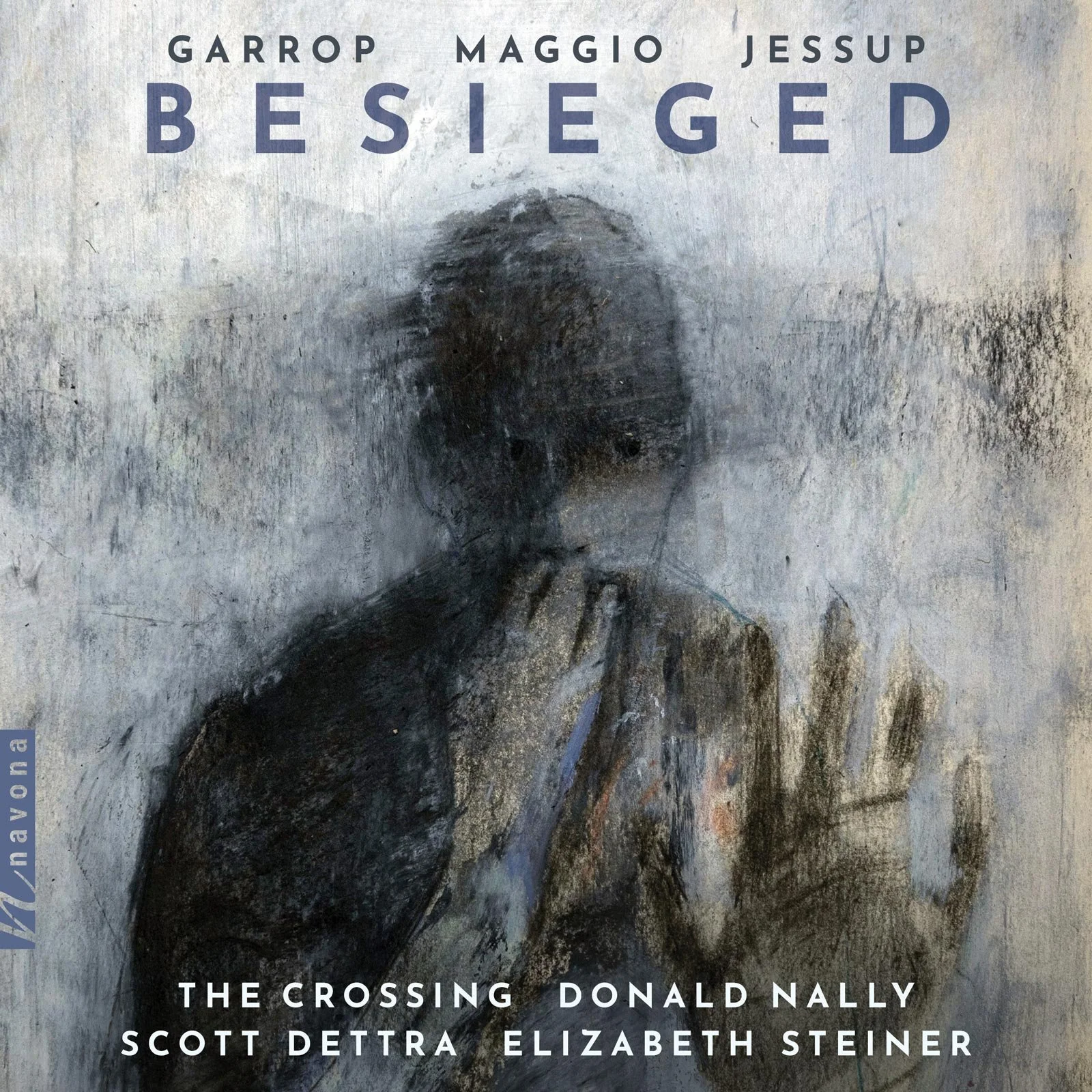
BESIEGED unites three contemporary composers whose choices of texts are widely varying: Stacy Garrop sets stories of Lydia Davis in which decay and disintegration are metaphors for old age and isolation. Robert Maggio alternates psychiatrist Dr. Alzheimer’s notes on his first diagnosed patient with her confused, frightening experience. And Christopher Jessup looks skyward, with Whitman, to ponder unanswerable questions about our being in relation to the stars. The Crossing, with its signature expressive precision, brings these works together, balancing sadness and wonder into a coherent journey of clarion sound, examining time spans — human life, aging, and the mysteries of the cosmos.
In a House Besieged
music by Stacy Garrop
words by Lydia Davis
Commissioned by the Cleveland Museum of Art, Tom Welsh, Director of Performing Arts, Music and Film; with generous support of the Musart Society, in honor of Robert G. Schneider. Written for The Crossing, Donald Nally, and Scott Dettra.
a note from the composer:
In a House Besieged features several short stories by contemporary American writer Lydia Davis that reflect the fear and anxiety that accompany the aging process. We see our homes and the world around us crumble and decay with time; can we admit that our bodies and minds will do the same? If we are lucky enough to grow old, will we remember who we are?
The piece presents five stories over the course of five movements, each highlighting various aspects of the aging process. Two additional fragments woven between these movements serve as a prologue, a series of interludes, and an epilogue. One fragment consists of the sounds someone makes while trying to recall how to pronounce the word “woman.” The other fragment, when fully heard at the end of the piece, illustrates the rising apprehension a person experiences with the onset and progression of dementia.
Prologue
(from “Suddenly Afraid”)
a wa wam
(from “The Busy Road”)
I am so used to it
A Natural Disaster (from The Collected Stories of Lydia Davis)
In our home here by the rising sea we will not last much longer. The cold and the damp will certainly get us in the end, because it is no longer possible to leave: the cold has cracked open the only road away from here, the sea has risen and filled the cracks down by the marsh where it is low, has sunk and left salt crystals lining the crack, has risen again higher and made the road impassable.
The sea washes up through the pipes into our basins, and our drinking water is brackish. Mollusks have appeared in our front yard and our garden and we can’t walk without crushing their shells at every step. At every high tide the sea covers our land, leaving pools when it ebbs, among our rosebushes and in the furrows of our rye field. Our seeds have been washed away; the crows have eaten what few were left.
Now we have moved into the upper rooms of the house and stand at the window watching the fish flash through the branches of our peach tree. An eel looks out from below our wheelbarrow.
Interlude
(from “Suddenly Afraid”)
a wa wam owm
(from “The Busy Road”)
I am so used to it by now
Almost No Memory (from Almost no Memory)
A certain woman had a very sharp consciousness but almost no memory. She remembered enough to get by from day to day.
Sometimes she would only read and think, and sometimes she would make a note in her current notebook of what she was reading in a notebook from an earlier time, or she would make a note of an idea that came to her from what she was reading.
Although most of what she read was new to her, sometimes she immediately recognized what she read and had no doubt that she herself had written it, and thought it. It seemed perfectly familiar to her, as though she had just thought it that very day, though in fact she had not thought it for some years, unless reading it again was the same as thinking it again, or the same as thinking it for the first time, and though she might never have thought it again, if she had not happened to read it in her notebook. And so she knew by this that these notebooks truly had a great deal to do with her.
Interlude
(from “Suddenly Afraid”)
a wa wam owm
Owamn womn
(from “The Busy Road”)
I am so used to it by now
That when the traffic falls silent,
The Cottages: 2. Lillian (from The Collected Stories of Lydia Davis)
I look out from time to time and she is still sitting there alone, and she will not call them for fear of being a nuisance, and because she is disappointed she begins to think as she has thought before that she is too far away, she will not come back to this cottage again though she has come here for so many years, first with her husband, then without her husband, who died between one summer and the next, and she is thinking too how she makes trouble for everyone; well, no one minds! I have told her, but she will never believe that any more than she will uncover her old body to swim in company with the other old people here, and goes down to the lake alone at dawn; and now she puts away her book and her glasses and her shoes untied by the bed, and goes to bed, for it is evening, and she likes to lie and watch the darkness come down into the woods, though tonight, as sometimes before, she does not really watch, or though her eyes rest on the darkening woods, she is not so much watching as waiting, and often, now, feels she is waiting.
Interlude
(from “Suddenly Afraid”)
a wa wam owm
Owamn womn
(from “The Busy Road”)
I am so used to it by now
That when the traffic falls silent,
Order (from Varieties of Disturbance)
All day long the old woman struggles with her house and the objects in it; the doors will not shut; the floorboards separate and the clay squeezes up between them; the plaster walls dampen with rain; bats fly down from the attic and invade her wardrobe; mice make nests in her shoes; her fragile dresses fall into tatters from their own weight on the hanger; she finds dead insects everywhere. In desperation she exhausts herself sweeping, dusting, mending, caulking, gluing, and at night sinks into bed holding her hands over her ears so as not to hear the house continue to subside into ruin around her.
Interlude
Suddenly Afraid (from Varieties of Disturbance)
because she couldn’t write the name of what she was: a wa wam owm
Owamn womn
In a House Besieged (from Break it Down)
In a house besieged lived a man and woman. From where they cowered in the kitchen the man and woman heard small explosions. “The wind,” said the woman. “Hunters,” said the man. “The rain,” said the woman. “The army,” said the man. The woman wanted to go home but she was already home, there in the middle of the country in a house besieged.
Epilogue
The Busy Road (from The Collected Stories of Lydia Davis)
I am so used to it by now
That when the traffic falls silent,
I think a storm is coming.
— Texts by Lydia Davis. Excerpted or used in full; they are taken from the following short stories: “Suddenly Afraid,” “The Busy Road,” “A Natural Disaster,” “Almost No Memory,” “The Cottages: 2. Lillian,” “Order,” and “In a House Besieged.” Used with permission.
The Woman Where We Are Living
music by Robert Maggio
words by Alois Alzheimer
Commissioned by The Crossing and Donald Nally, and made possible with support from the Knight Foundation.
a note from the composer:
On November 25, 1901, a 51-year-old woman named Auguste Deter (1850–1906) was admitted to the Hospital for the Mentally Ill and Epileptics in Frankfurt, and was examined by German Physician Alois Alzheimer (1864–1915). Deter’s initial symptoms included impaired memory, aphasia, disorientation, and psychosocial incompetence. Her condition gradually worsened, and she started losing other cognitive functions and experiencing hallucinations. Because of her age, Deter was diagnosed with presenile dementia; today, the diagnosis would be early-onset Alzheimer’s Disease. Deter died in April 1906, aged 55.
The text of The Woman Where We Are Living is excerpted from Alzheimer’s journal entries in which he chronicles his observations of and conversations with Deter. The music explores the fluctuating states of Deter’s deteriorating mind. Mahler’s Symphony No. 4 premiered the same day as Alzheimer and Deter first met. Its theme of spiritual transformation and meditation on the journey toward innocence serve as a point of departure for this score. The Woman Where We Are Living begins with a quotation from the final moments of Mahler’s Fourth: the voice of a child describing a pastoral vision of Heaven.
The Woman Where We Are Living is dedicated to my mother.
1. Die englischen Stimmen
Die englischen Stimmen Ermuntern die Sinnen
Daß alles für Freuden erwacht.
2. The reactions of the pupils to light
The reactions of the pupils to light and accommodation are instantaneous.
Tongue has normal mobility, dry, yellow-red-brown.
No disturbance in speech articulation.
She frequently interrupts herself in the articulation of words during the interview
(as if she did not know whether she had said something correctly or not).
She has dentures.
No facial nerve differences.
Muscular strength: at the left side considerably reduced compared with the right side.
Patellar reflex normal.
Radial reflex is slightly (but not relevantly) rigid.
Cardiac ictus is not felt.
Cardiac obtusity not enlarged.
The second pulmonary and aortic tones are not accentuated.
She suddenly says, Just now, a child called. Is he there?
3. Wie Heißen Sie?
Wie heißen Sie?
Auguste.
Familiename?
Auguste.
Wie heißt Ihr Mann?
Auguste, I think.
Ihr Mann?
Ah, my husband.
Sind Sie verheiratet?
To Auguste.
Frau Deter?
Yes, yes, Auguste Deter
Wie alt sind sie?
Fifty one.
Wo wohnen Sie?
Oh, have you been to our place?
4. When she was brought from the isolation room
(I will not be cut)
When she was brought from the isolation room to the bed she became agitated, screamed, was non-cooperative;
showed great fear and repeated
I will not be cut.
I do not cut myself.
5. Wo wohnen Sie?
Wo wohnen Sie?
I can tell you, I must wait a bit.
Was habe Ich bitten Sie nur?
Well, this is Frankfurt am Main.
Auf welcher Straße wohnen Sie?
Waldemarstreet, not, no…
Wann haben Sie geheiratet?
I don’t know at present. The woman lives on the same floor.
Welche Frau?
The woman where we are living.
6. When the doctor enters the room
(make yourself comfortable)
When the doctor enters the room she tells him to stay away
other times she greets him as if he were a dear guest.
Make yourself comfortable, until now I haven’t had time.
7. Welche Frau?
Welche Frau?
Wann haben Sie geheiratet?
Auf welcher Straße wohnen Sie?
Was habe Ich bitten Sie nur?
Wo wohnen Sie?
Wie alt sind sie?
Wie heißt Ihr Mann?
Wie heißen Sie?
8. She acts as if she were blind
(myself in order)
She acts as if she were blind
touching the other patients on their faces
and when asked what she is doing, replies
I must put myself in order.
9. When she died, she was examined
(here and everywhere, here and now)
When she died, she was examined by two of Alzheimer’s colleagues, who recorded the death in her medical file as follows:
During the morning exitus letalis; cause of death: septicaemia due to decubitus; anatomical diagnosis: moderate hydrocephalus (external internal); cerebral atrophy; arteriosclerosis of the small cerebral blood vessels; ? ; pneumonia of both inferior lobes; nephritis.
Wo sind Sie jetz?
Here and everywhere, here and now…
Wo sind Sie in diesem Moment?
This is where I will live.
Here and everywhere, here and now
Astronomia
music by Christopher Jessup
words by Walt Whitman
a note from the composer:
Astronomia is a set of three a cappella choral works, each of which use poems by Walt Whitman that center around the theme of astronomy. The first movement, “When I Heard the Learn’d Astronomer,” captures the moment when intellect gives way to intuition, and analytical observation yields to personal, lived experience. In the poem, the speaker listens to a scientific lecture on astronomy, filled with data and diagrams, but soon finds himself disengaged, longing instead for a direct encounter with the stars. Quietly slipping away, he looks up at the night sky in silence, finding a deeper, more spiritual connection with the cosmos. Set to music, this poem invites the choir to explore the contrast between the structured world of reason and the transcendent wonder of simply “looking up in perfect silence at the stars.” The piece is a journey from the noise of the mind to the stillness of the soul.
The second movement, “The Mississippi at Midnight,” is a brief but evocative piece about the quiet power and vastness of nature. In this poem, the mighty river becomes a symbol of timeless flow and silent strength, moving steadily through the stillness of night. Whitman’s language conjures an atmosphere of mystery and awe, inviting reflection on the immensity of the natural world and humanity’s place within it. This piece invites the listener to stand with Whitman on the riverbank, immersed in the beauty and solemnity of the midnight current.
The third movement, “Kosmos,” serves as a profound meditation on the expansive nature of the self and its deep connection to the universe. In this text, Whitman celebrates a human identity that embraces diversity, physicality, spirituality, intellect, and time itself. With sweeping inclusivity, he presents the self as a microcosm of the earth and cosmos — capable of holding contradiction, sensing beauty, engaging with history, and reaching toward the infinite. This piece invites both performers and listeners to inhabit Whitman’s boundless vision of humanity: one that sees the body as sacred, the mind as exploratory, and the spirit as deeply attuned to the rhythms of nature and society. The music, like the poem, becomes an expression of vast inner and outer harmony.
I. When I Heard the Learn’d Astronomer
When I heard the learn’d astronomer,
When the proofs, the figures, were ranged in columns before me,
When I was shown the charts and diagrams, to add, divide, and measure them,
When I sitting heard the astronomer where he lectured with much applause in the lecture-room,
How soon unaccountable I became tired and sick,
Till rising and gliding out I wander’d off by myself,
In the mystical moist night-air, and from time to time,
Look’d up in perfect silence at the stars.
II. The Mississippi at Midnight
How solemn! sweeping this dense black tide!
No friendly lights i’ the heaven o’er us;
A murky darkness on either side,[And kindred darkness all before us!
Now, drawn nearer, the shelving rim,
Weird-like shadows suddenly rise;
Shapes of mist and phantoms dim
Baffle the gazer’s straining eyes.
River fiends, with malignant faces!
Wild and wide their arms are thrown,
As if to clutch in fatal embraces
Him who sails their realms upon.
Then, by the trick of our swift motion,
Straight, tall giants, an army vast,
Rank by rank, like the waves of ocean,
On the shore march stiffly past,
How solemn! the river a trailing pall,
Which takes, but never again gives back;
And moonless and starless the heaven’s arch’d wall,
Responding an equal black!
Oh, tireless waters! like Life’s quick dream,] Onward and onward ever hurrying—
Like Death in this midnight hour you seem,
Life in your chill drops greedily burying!
– bracketed text omitted by the composer.
III. Kosmos
Who includes diversity and is Nature,
Who is the amplitude of the earth, and the coarseness and sexuality of the earth, and the great charity of the earth and the equilibrium also,
Who has not look’d forth from the windows the eyes for nothing, or whose brain held audience with messengers for nothing,
Who contains believers and disbelievers, who is the most majestic lover,
Who holds duly his or her triune proportion of realism, spiritualism, and of the æsthetic or intellectual,
Who having consider’d the body finds all its organs and parts good,
Who, out of the theory of the earth and of his or her body understands by subtle analogies all other theories,
The theory of a city, a poem, and of the large politics of these States;
Who believes not only in our globe with its sun and moon, but in other globes with their suns and moons,
Who, constructing the house of himself or herself, not for a day but for all time, sees races, eras, dates, generations,
The past, the future, dwelling there, like space, inseparable together.
THE CROSSING
Walter Aldrich J • Nathaniel Barnett M/G • Jessica Beebe M/G, J • Kelly Ann Bixby M/G • Karen Blanchard M/G, J • Steven Bradshaw M/G, J • Aryssa Burrs M/G, J • Colin Dill M/G, J • Micah Dingler M/G • Ryan Fleming M/G • Joanna Gates M/G, J • Michaël Hudetz J • Steven Hyder M/G, J • Michael Jones J • A.J. Keller M/G • Lauren Kelly M/G • Anika Kildegaard M/G, J • Chelsea Lyons M/G • Andrew Major J • Hannah Dixon McConnell J • Elijah McCormack M/G • Jenna Hernandez McLean J • Maren Montalbano M/G, J • Rebecca Myers J • Benjamin Perri J • Olivia Prendergast J • James Reese J • Daniel Schwartz M/G, J • Thann Scoggin M/G, J • Rebecca Siler M/G, J • Tiana Sorenson M/G • Daniel Spratlan M/G, J • Elisa Sutherland J • Daniel Taylor M/G • Jackson Williams M/G
Scott Dettra, organ
Elizabeth Steiner, harp
M/G Maggio and Garrop
J Jessup
Donald Nally, conductor
Kevin Vondrak, associate conductor
John Grecia, company keyboardist
Lee Hagon, guest keyboardist
Paul Vazquez, sound designer
Jackson Pierzina, summer associate (2024)
Christian Johnson, summer associate (2025)
Recording Producers: Paul Vazquez, Donald Nally, Kevin Vondrak
Recording Engineer: Paul Vazquez
Assistant Engineer: Codi Yhap (tracks 1-16)
Editing, Mixing & Mastering: Paul Vazquez
Album artwork by Rita Quattrocchi
Recorded June 14, 2024 & June 21, 2025 at The Presbyterian Church of Chestnut Hill in Philadelphia, Pennsylvania.
In a House Besieged was recorded on The Mander Organ.
This album was made possible through the generous support of Carol Westfall.